Children experience a wide range of emotions every day. Excitement about seeing friends, frustration when learning feels difficult, disappointment when things do not go as planned, or anxiety about new experiences. Learning to recognise, understand and manage these emotions is a crucial part of healthy development.
While emotional development begins in the early years, it continues throughout childhood and adolescence. Schools are uniquely placed to support this journey. Through everyday interactions, classroom activities, and emotionally supportive relationships, schools can help children develop the emotional literacy and confidence they need to navigate life’s challenges.
Through our work in the Nursery Inclusion Project for All (NIPA), Educational Psychologists have seen first-hand how creating space for emotional development can positively influence children’s wellbeing, relationships and readiness to learn. NIPA is a multidisciplinary early years project which includes a strong focus on children’s emotional development. While this work takes place within nursery settings, many of the approaches we promote could be adapted and applied across different ages and stages of education. Creating emotionally supportive environments is not only relevant in the early years; it remains important throughout childhood and adolescence.
Why Emotional Development Matters
Emotional development is about more than helping children feel happy. It involves learning to:
- Recognise emotions in themselves and others.
- Understand why emotions occur.
- Express feelings appropriately.
- Manage difficult emotions.
- Develop empathy and perspective-taking skills.
- Build positive relationships.
- Seek support when needed.
These skills form the foundation of emotional wellbeing and resilience. They also support learning. Children who can identify and regulate their emotions are often better able to focus attention, solve problems, manage social situations, and cope with setbacks.
Importantly, emotional development is not something that happens only during dedicated wellbeing lessons. It develops through thousands of everyday interactions with trusted adults and peers.
Through NIPA, we regularly support nursery staff to develop their understanding of attachment, attunement, emotion coaching and emotional resilience. One of the key messages that emerges from this work is that emotional development happens within relationships. Children are continually learning about emotions through their interactions with trusted adults who listen, validate feelings and help them make sense of their experiences.
Building Emotional Literacy Through Everyday Opportunities
One of the most effective ways to support emotional development is to make conversations about feelings a normal part of school life.
When children regularly hear emotions being named, discussed, and validated, they gradually build a richer emotional vocabulary and a deeper understanding of themselves and others.
Simple opportunities might include:
- Discussing how characters feel during story time.
- Exploring emotional reactions during current events discussions.
- Reflecting on feelings after playground incidents.
- Talking about emotions associated with success, challenge, and mistakes.
- Using circle times/class discussions to explore common emotional experiences.
Rather than viewing emotional conversations as additional tasks, schools can weave them into existing routines and curriculum activities.
The Power of Check-Ins
Registration and welcome activities can provide valuable opportunities for children to share how they are feeling.
Many schools are finding creative ways to help children communicate their emotional state, including:
- Mood boards or emotion check-in displays.
- Colour-coded systems.
- Feelings scales.
- Daily reflection journals.
- Brief verbal check-ins.
- Digital wellbeing surveys for older pupils.
These approaches do not need to be lengthy. A simple check-in can help children pause, reflect, and feel noticed.
For staff, check-ins can provide useful information about how children are arriving at school and whether additional support may be needed.
Perhaps most importantly, they send a powerful message:
“Your feelings matter here.”
In many of the nurseries involved in NIPA, practitioners are encouraged to check in with children daily and provide opportunities for them to communicate how they are feeling. Staff often report that these small moments help children feel seen, understood and valued. Similar approaches could be embedded across schools, for example through morning registration activities, tutor time or pastoral check-ins. While the methods may differ depending on age, the message remains the same: children’s emotions are important and worthy of attention.
Creating Emotionally Supportive Environments
Through our NIPA work, we have observed that emotional development is supported most effectively when it becomes part of the everyday environment rather than a stand-alone intervention. Practitioners and teachers can create opportunities for emotional learning through displays, visual supports, dedicated spaces for regulation and regular conversations about feelings.
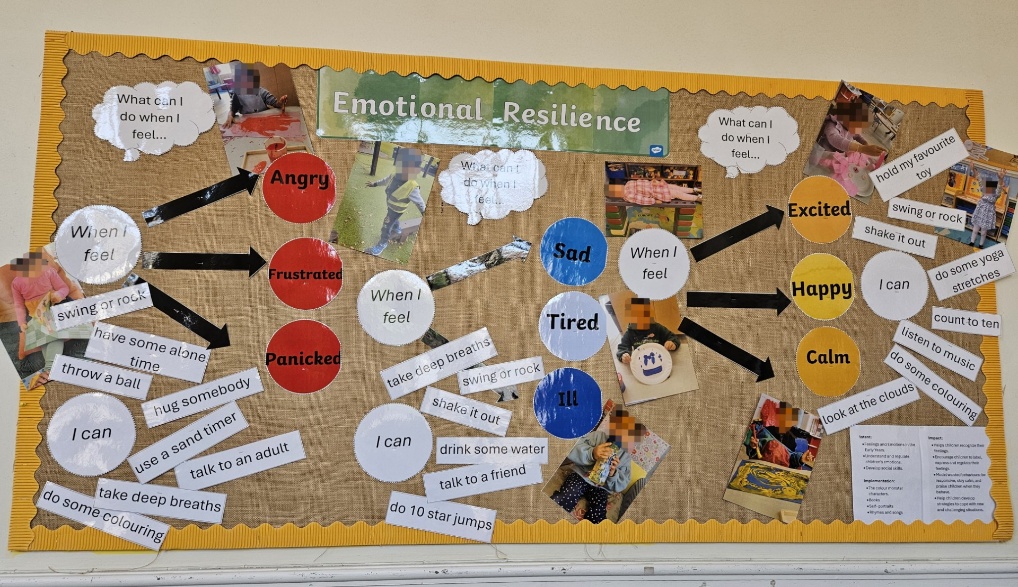
For example, settings may create emotional literacy displays, emotional resilience boards or calming spaces where children can practise self-regulation strategies. These approaches help communicate that all emotions are normal, valid and manageable. The goal is not to eliminate difficult feelings, but to help children recognise, express and respond to them in healthy ways.
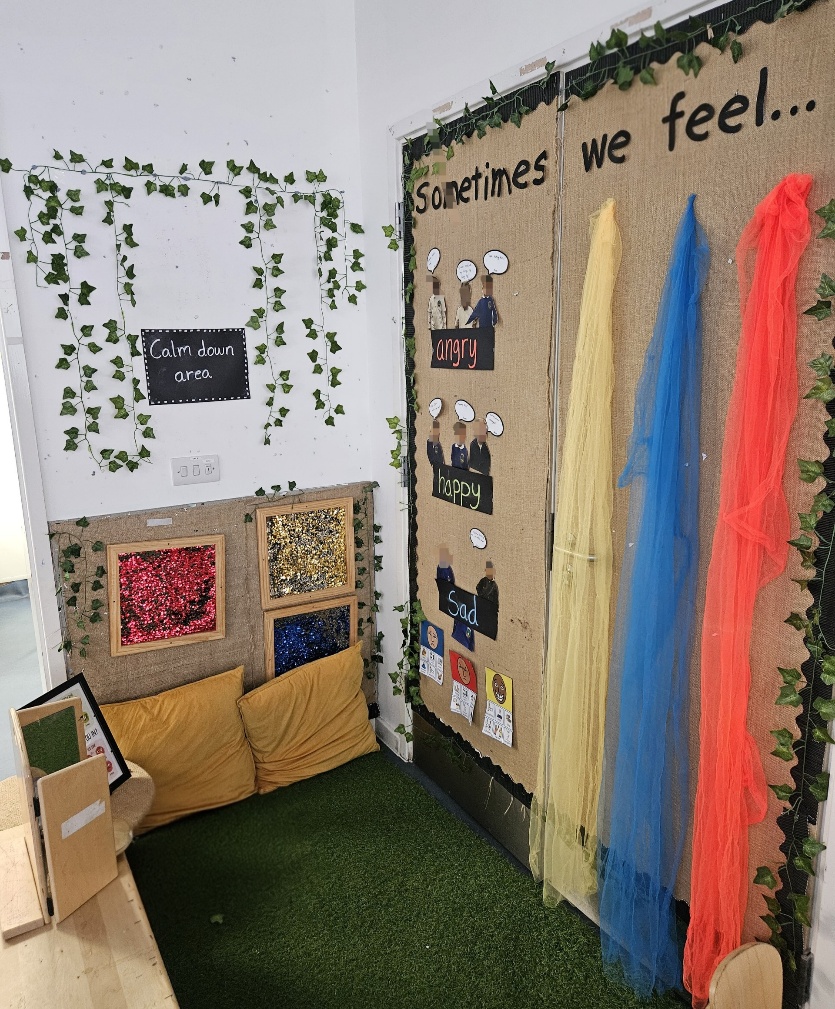
Similar approaches could be adapted for different age groups, ensuring that emotional development remains a visible and valued part of the school environment throughout a child’s educational journey.
Circle Time as a Safe Space for Emotional Learning
Circle time can provide a structured opportunity for children to develop emotional awareness alongside their peers.
When facilitated sensitively, circle times can help children:
- Practise talking about feelings.
- Listen to different perspectives.
- Develop empathy.
- Learn emotional vocabulary.
- Explore problem-solving strategies.
- Build a sense of belonging.
Discussion prompts might include:
- What helps you feel calm when something goes wrong?
- What does being a good friend look like?
- How can we tell when someone needs support?
- What makes us feel proud?
- What can we do when we feel worried?
The goal is not to encourage children to disclose highly personal experiences but to create regular opportunities for emotional reflection and shared learning.
Supporting Emotional Development Through Play and Learning
Children do not only learn about emotions through conversations. They also learn through play, exploration, creativity, and interaction.
Schools can create opportunities for emotional learning through:
Early Years
- Role-play areas.
- Emotion cards and visual supports.
- Storytelling.
- Puppet play.
- Sensory and imaginative play activities.
Primary School
- Emotion-focused PSHE activities.
- Drama and role-play.
- Reflection journals.
- Collaborative problem-solving tasks.
- Class discussions linked to literature.
Secondary School
- Tutor-time discussions.
- Wellbeing activities.
- Peer mentoring programmes.
- Reflection activities linked to personal development curricula.
- Opportunities to explore emotions through literature, art, and creative subjects.
Within NIPA, Educational Psychologists often model individual and group-based activities that support emotional literacy, emotional regulation and resilience. This may involve using stories, role play, visual resources, games and structured discussions to help children recognise feelings and practise coping strategies. Staff frequently report that observing these approaches in practice increases their confidence to continue the work independently. While activities may vary according to age and developmental stage, the underlying principles remain consistent across educational settings. Across all ages, emotional learning becomes most powerful when children can connect it to real-life experiences.
Helping Children Know Where to Go for Support
An important part of emotional development is helping children understand that everyone sometimes needs support.
Schools can support this by ensuring children know:
- Which adults they can talk to.
- How to access support.
- What happens when they ask for help.
- That seeking support is a strength rather than a weakness.
This may include:
- Worry boxes.
- Trusted adult systems.
- Visual displays showing support networks.
- Peer support programmes.
- Regular reminders about available help.
When support pathways are clear and accessible, children are more likely to seek help before difficulties become overwhelming.
A Whole-School Approach
While individual activities can be helpful, emotional development is most effectively supported through a whole-school approach.
Consider:
- How are emotions talked about across the school?
- Do children hear staff modelling emotional language?
- Are opportunities for emotional reflection built into daily routines?
- Do children know where to access support?
- Is emotional wellbeing viewed as everyone’s responsibility?
Small, consistent actions across the school day often have a greater impact than isolated interventions.
Books and Resources to Support Emotional Development
Early Years
- Feelings (Pat-a-Cake First Skills series): Supports young children to recognise and name emotions.
- The Colour Monster by Anna Llenas: Helps children identify and talk about different emotions.
- Ruby’s Worry by Tom Percival: Helps children understand worries and the importance of talking to others.
- The Invisible String by Patrice Karst: Supports conversations about connection, belonging, and relationships.
Primary Age
- Listening to My Body by Gabi Garcia: Encourages children to notice body sensations associated with different emotions.
- The Huge Bag of Worries by Virginia Ironside: Explores how worries can grow when kept hidden.
- What Should Danny Do? by Adir Levy and Ganit Levy: Encourages reflection on choices, consequences, and emotional responses.
- The Dot by Peter H. Reynolds: Frequently used for self-esteem and growth mindset.
- Only One You by Linda Kranz: Supports self-esteem and celebrating individuality.
- My Strong Mind by Niels Van Hove: Supports the development of emotional resilience and coping strategies.
- A Volcano in My Tummy by Elaine Whitehouse and Warwick Pudney: Helps children understand and manage feelings such as anger and frustration.
Secondary Age
- You’ve Got Dragons by Kathryn Cave: Helpful for exploring worries and challenges with older children.
- You Are Awesome by Matthew Syed: Explores resilience, challenge, and growth through an accessible framework.
- The Boy, the Mole, the Fox and the Horse by Charlie Mackesy: Encourages reflection on kindness, friendship, self-worth, courage, and resilience through simple yet powerful messages and illustrations.
- The Red Tree by Shaun Tan: Explores difficult feelings and hope.
- MindMate Resources (https://mindmate.org.uk/im-a-young-person/): Offers age-appropriate emotional wellbeing materials for older pupils.
- Youngminds (https://www.youngminds.org.uk/young-person/my-feelings/): Offers information, practical advice and resources for young people, parents, carers and professionals, as well as a free Parents.
- Kooth (https://www.kooth.com/): A free online mental health and wellbeing platform for young people.
How Educational Psychologists Can Help
Educational Psychologists (EPs) can support schools to develop a whole-school approach to emotional development and wellbeing. By working collaboratively with children, families and staff, EPs can help create environments where children feel understood, supported and able to thrive.
Support may include:
- Consultation with staff and school leaders to explore children’s needs and develop psychologically informed approaches.
- Training for school staff on emotional literacy, emotional regulation, relational approaches and emotionally supportive classroom practice.
- Workshops for parents and carers to build understanding of children’s emotional development and share practical strategies for supporting wellbeing at home.
- Facilitated reflective spaces and supervision for staff, providing opportunities to think together about children’s needs, strengthen practice and support staff wellbeing.
- Group interventions for children and young people, focusing on emotional literacy, resilience, friendships and emotional regulation.
- Modelling and coaching alongside staff, demonstrating approaches that promote emotional awareness and supportive conversations.
- Whole-school development work to embed emotional wellbeing within school culture, policies and everyday practice.
Through consultation, training and collaborative problem-solving, Educational Psychologists can help schools build emotionally literate communities where children feel safe to express their feelings, seek support when they need it, and develop the skills for lifelong wellbeing.
Final Thoughts
Working within NIPA has reinforced the importance of making emotional development everyone’s business. Time and again, we hear from early years practitioners that having a shared language around emotions, opportunities for reflection, and environments that actively support emotional wellbeing can make a meaningful difference to children.
Whilst the examples in this article draw on learning from early years settings, the underlying principles are relevant throughout education. Whether it is a nursery practitioner welcoming a child into the setting, a primary teacher facilitating a class discussion, or a secondary tutor checking in during registration, small relational interactions can have a significant impact.
Emotional development does not require a separate curriculum or expensive resources. Often, it begins with simple but intentional practices: noticing feelings, validating emotions, creating opportunities for reflection and helping children develop the language to understand themselves and others. By making space for feelings, schools can help children and young people build the emotional literacy, resilience and confidence needed to navigate both learning and life.